
Customs Clearance Dubai: Step by Step Guide for Importers and Exporters (2026)
If your goods are stuck at Jebel Ali Port or Dubai International Airport, the problem is almost always the same, missing documents, a wrong HS code, or a step skipped in the customs clearance process.
This guide covers everything you need to know about customs clearance in Dubai in 2026: the exact steps, required documents, costs, timelines, common mistakes, and how to get your cargo moving as fast as possible.
What Is Customs Clearance in Dubai?
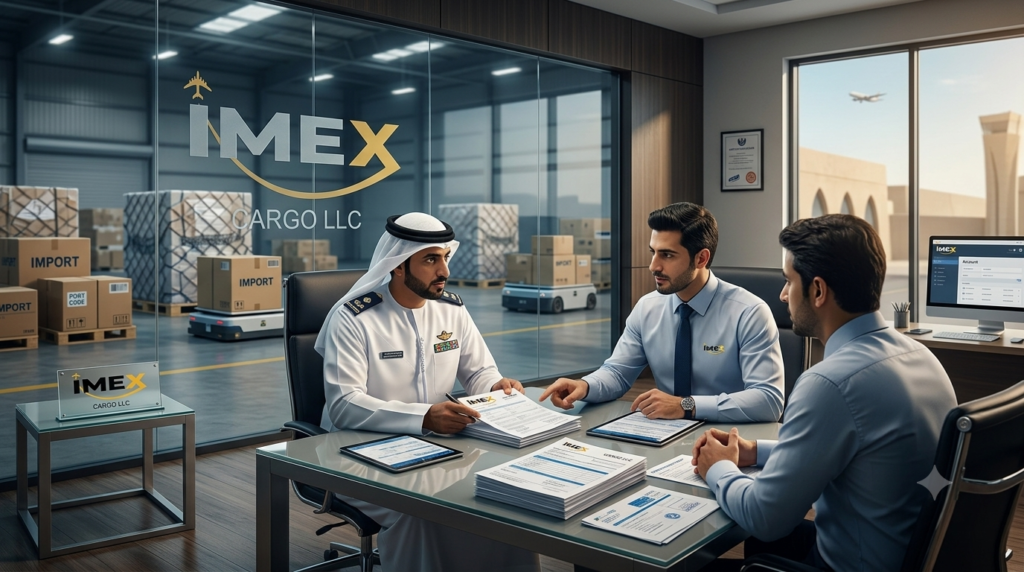
Customs clearance Dubai is the official process of submitting documentation, paying applicable duties, and receiving approval from Dubai Customs before your goods can legally enter or leave the UAE.
Every shipment passing through Jebel Ali Port, Port Rashid, or Dubai International Airport must go through this process. Without it, your cargo does not move.
Dubai Customs processes all declarations through Mirsal 2, the UAE’s official digital customs platform, integrated with the Dubai Trade Portal at dubaitrade.ae.
Step by Step: How Customs Clearance Works in Dubai (2026)
Before your first shipment arrives, your company must be registered with Dubai Customs and hold an active customs business code through the Dubai Trade Portal.
This code is directly linked to your UAE trade license and VAT TRN. Without it, Mirsal 2 will not allow any declarations to be filed, and your goods cannot be cleared.
Important: Companies in free zones like JAFZA are automatically registered when they acquire their license. For all other businesses, registration must be completed separately from your trade license.
Step 2: Prepare Your Documentation
Documentation is where most delays happen. Every document must be accurate, stamped, and aligned with the shipment details before submission.
Here is what you need for standard imports into Dubai:
| Document | Purpose |
|---|---|
| Commercial Invoice | Declares the value, description, and quantity of goods. Must be on company letterhead, signed and stamped. |
| Packing List | Lists number of packages, dimensions, and weight. |
| Certificate of Origin | Confirms where the goods were manufactured. Issued by the Chamber of Commerce. |
| Bill of Lading or Airway Bill | Proof of shipment and transport details. |
| Import Declaration | Filed through the Dubai Trade Portal declaring shipment contents and value. |
| Trade License Copy | Confirms the importer is legally registered to trade in the UAE. |
| Customs Duty Payment Proof | Receipt showing all duties and VAT have been paid. |
| Special Permits (if required) | For restricted goods such as food, chemicals, pharmaceuticals, cosmetics, or electronics. |
2026 Update: The UAE now requires 12-digit HS codes under the GCC Integrated Customs Tariff. Using outdated 8-digit codes is one of the most common causes of declaration queries and shipment holds. Always verify your HS classification before filing.
Step 3: File the Customs Declaration
Once documents are ready, the importer or their appointed customs clearing agent files a declaration through the Dubai Trade Portal (dubaitrade.ae).
The portal automatically checks the data against customs regulations. If everything matches, the declaration is approved digitally.
Pro Tip: You can submit declarations before your cargo arrives. Pre-arrival submission through Mirsal 2 allows your declaration to be reviewed while goods are still in transit, which significantly reduces clearance time once the shipment lands. Since January 2026, early submission also protects you from amendment fines on sea cargo.
Step 4: Pay Customs Duties and VAT
Dubai’s standard customs duty is 5% of the CIF value (Cost, Insurance, and Freight). VAT is an additional 5%.
Free zone shipments may qualify for duty exemptions until goods move to the UAE mainland.
Payment is made through the Dubai Trade Portal via e-Dirham, G2B credit transfers, or the Digital MAKASA system for GCC cross-border movements.
Restricted goods have higher rates:
- Alcohol: 50% customs duty
- Tobacco and cigarettes: 100% customs duty
Step 5: Customs Inspection (if applicable)
Dubai Customs uses an AI-driven risk assessment system that classifies your shipment into one of three channels:
- Green Channel: Automatic electronic clearance. No physical inspection needed.
- Yellow Channel: Document review required before release.
- Red Channel: Physical inspection required. Officers may use X-ray scanners or manually open containers.
Being flagged for a Red Channel adds 1 to 3 business days to your clearance time. Accurate documentation and correct HS classification reduce the probability of this happening.
For restricted goods such as food, pharmaceuticals, and chemicals, a representative from the relevant ministry may also be required during inspection.
Step 6: Collect the Delivery Order and Release Cargo
Once customs approves your shipment, you collect the delivery order from the shipping line or airline. This is the legal document that authorises the port or warehouse to release your goods to you physically.
At this point, you coordinate with your freight forwarder or transport company for final delivery to your warehouse, distribution centre, or retail location.
The honest answer depends on how well-prepared your documentation is.
| Shipment Type | Typical Timeline |
|---|---|
| Air freight, complete documents | A few hours to 1 business day |
| Sea freight, complete documents | 24 to 48 hours |
| Shipments flagged for Yellow Channel | Add 1 additional day |
| Shipments flagged for Red Channel | Add 1 to 3 additional days |
| Restricted or regulated goods | Up to 1 week or more |
| Incomplete documentation | Unpredictable, often several weeks |
The cases that take longest are rarely the complex ones. They are routine shipments with a single wrong digit in the HS code, an expired customs registration, or a regulatory approval that was assumed to be in order but was never confirmed.
Frequently Asked Questions About Customs Clearance in Dubai
Q: Do I need my own customs registration even if I use a clearing agent?
Yes. Even if a clearing agent handles the physical clearance, your company still needs its own Dubai customs registration and customs code. The clearing agent uses your code when processing your shipments.
Q: How do I find the right HS code for my product?
You can search the GCC Unified Customs Tariff on the Dubai Customs website or the Dubai Trade Portal. For complex classifications, a licensed customs broker can advise on the correct 12-digit code for your specific goods.
Q: Is my Dubai customs registration valid at all UAE ports?
Dubai customs registration covers Dubai ports, airports, and borders including Jebel Ali Port, Port Rashid, and Dubai International Airport. If you are importing through Abu Dhabi, Sharjah, or other emirates, separate registration with those customs authorities may be required.
Q: Does IMEX Cargo handle customs clearance for dangerous goods?
Yes. IMEX Cargo is certified to handle all classes of dangerous goods (DG) cargo, including perfumes, chemicals, lithium batteries, and aerosols. We manage the complete documentation and clearance process for DG shipments through our JAFZA facility in compliance with IATA and IMDG regulations.